
A well-planned backyard play area can give Lancaster, Pennsylvania, families a dependable place for children to move, imagine, and spend time outdoors. The goal is not to fill every open corner with equipment. It is to create a layout that fits the yard, gives adults a clear view, and leaves children room to use each feature safely.
Start with the children who will use the space, then build the plan around their needs and your property’s conditions. Simple additions can refresh a familiar setup as interests change, and families can enhance playtime with swing set accessories while keeping the overall layout open and easy to supervise.
Start With the Space
Measure before choosing equipment. A backyard that looks generous from the patio can become tight once a slide exit, swing path, seating area, and fall surface are included. In Lancaster County, take note of established trees, uneven ground, fence lines, patios, garden beds, and places where rainwater collects after a storm.
Choose a level location away from driveways, pools, grills, tool storage, and busy walkways. The best placement also gives supervising adults a full view from the house, porch, or designated seating area. Before installation, follow a simple planning sequence:
- Measure the available space.
- Mark fixed hazards and drainage concerns.
- Select the most practical location.
- Allow open room around moving and climbing features.
- Sketch the layout before anything is installed.
Match Play Features to Age and Ability
A play area should fit a child’s current size, confidence, coordination, and judgment. Toddlers generally need low platforms, easy steps, secure handholds, and close supervision. Preschoolers may enjoy short slides, simple climbers, and pretend-play spaces. Older children may be ready for more challenging climbing, balancing, and swinging features.
Age labels provide useful guidance, but adult judgment matters just as much. A young child should not be encouraged to use a structure intended for substantially older children simply because an older sibling can use it. Adjustable swings, replaceable components, and open space for future changes can help the play area grow with the family without becoming crowded from the start.
Build a Safe Foundation
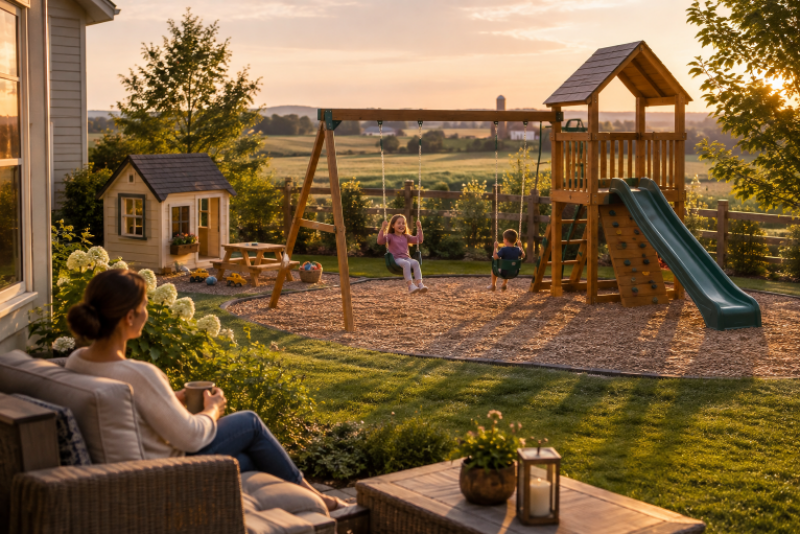
The ground beneath equipment needs as much attention as the equipment itself. Falls often cause playground injuries, so impact-absorbing surfacing reduces injuries by cushioning falls. Grass and bare soil may look comfortable but don’t absorb impact like loose-fill surfacing or safety-tested mats. Follow installation instructions and maintain proper depth of loose-fill. The U.S. Consumer Product Safety Commission recommends a minimum of 6 feet of protective surfacing around most equipment. Swings require extra clearance in front and behind. Recheck the surface after heavy rain, settling, or active play. Rake displaced material, remove rocks and sticks, and fix puddles to prevent mud and slips.
Balance Active and Imaginative Play
A memorable backyard supports more than one kind of play. Active features can invite climbing, swinging, sliding, balancing, and movement. Imaginative options, such as a playhouse area, steering wheel, chalkboard, or small outdoor kitchen, can turn the same space into a store, ship, workshop, or fort.
Give each kind of play a place
- Active play: Leave room for climbing, balance, and whole-body movement.
- Imaginative play: Add flexible items that encourage storytelling and pretend games.
- Social play: Provide enough open space for siblings and friends to take turns without crowding.
- Quiet play: Include a shaded spot for drawing, reading, water breaks, or a reset between games.
For a smaller Lancaster backyard, one climbing feature and one imaginative feature may serve children better than several attachments packed closely together. An open room is part of the play area, not wasted space.
Plan the Use Zones
Divide the yard into zones for motion, climbing, waiting, and supervision. Keep slide exits free of benches, toys, trees, and garden borders. Keep the swing path clear, and place adult seating outside the fall zone with a clear view of children. Visible boundaries help children understand expectations. Use mulch borders, low edging, or ground changes to define play zones without creating hidden corners. Proper spacing reduces the risk of children crossing paths unexpectedly.
Check Equipment Often
A quick monthly inspection helps families notice small problems before they become larger ones. Check bolts, caps, anchors, chains, ropes, seats, handles, climbing surfaces, and connection points. Look for rust, cracks, splinters, loose hardware, sharp edges, and missing protective caps.
Also, inspect the surfacing and remove standing water, broken toys, sticks, and other trip hazards. If any part is damaged or unstable, stop using it until it is repaired or replaced. Keep installation instructions, maintenance notes, and replacement-part details together so routine care is easier to manage.
Create Simple Play Rules
Short rules are easier for children to remember and for adults to reinforce:
- Wait until the bottom of the slide is clear.
- Walk around, moving swings, not in front of them.
- Use slides feet first.
- Keep ropes, cords, pet leashes, and drawstring clothing away from equipment.
- Take turns when a feature is busy.
- Keep food, glass, and hard toys outside the play zone.
Make the Space Last
Lancaster’s changing seasons make regular care important. Check wood for splinters and weathering, metal for rust, plastic for cracks, and ropes for fraying. Watch shade patterns through the year, since a location that feels comfortable in spring may be much warmer during summer afternoons.
Drainage also protects the space. Direct water away from the play area where possible, and store removable accessories before severe weather. A clean, maintained yard is more inviting for everyday play and easier to inspect.
Final Checklist
- Is the play area level and easy for adults to see?
- Does the surfacing help cushion falls?
- Is there enough room around swings, slides, and climbers?
- Do the features fit the children using them now?
- Are anchors, fasteners, ropes, and seats in good condition?
- Are slide exits and swing paths clear?
- Can children remember the play rules?
- Is an adult available to supervise active play?
A great backyard play area does not need to be oversized or packed with features. In Lancaster, Pennsylvania, careful spacing, dependable surfacing, age-appropriate choices, and routine inspections can turn an ordinary yard into a place children will want to enjoy again and again.


